
GaN technology in a charger means the charger uses gallium nitride semiconductor components in its power-conversion circuitry. Compared with traditional silicon-based designs, GaN can switch at higher frequencies, which helps engineers build chargers with high power density, smaller components, and efficient power conversion.
In practical terms, a GaN charger can deliver substantial power without requiring the bulky design of many older chargers. However, GaN is not the same thing as USB-C or USB Power Delivery (PD). GaN describes the power technology inside the charger, while USB-C describes the connector and USB PD is a power-delivery protocol.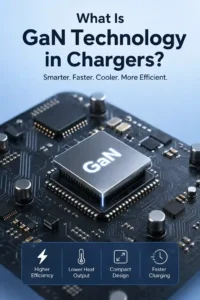
Quick Answer: A GaN charger uses Gallium Nitride instead of relying solely on traditional silicon power components. GaN allows faster switching and high power density, which can help make chargers smaller, lighter, and more efficient.
What Is a GaN Charger?
A GaN charger is a power adapter that uses Gallium Nitride, or GaN, in its power electronics. The technology helps the charger handle high-frequency switching while maintaining high power density.
Related Posts
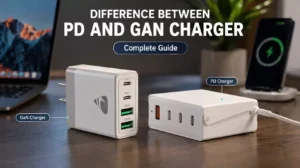 | Difference Between PD and GaN Charger: What’s the Difference? |
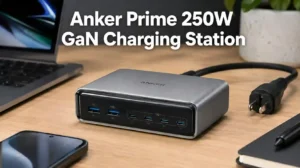 | Anker Prime 250W GaN Charging Station: Is It Still Worth Buying? |
Traditional chargers commonly use silicon-based power components. GaN offers electrical characteristics that can allow charger designers to reduce switching losses and shrink parts of the power-conversion system.
That is why many modern GaN chargers can provide high wattage from relatively compact housings.
What Does GaN Mean in a Charger?
GaN stands for Gallium Nitride. It is a semiconductor material used in power electronics, including AC-to-DC adapters, laptop chargers, and USB chargers.
The important point is that GaN does not describe the charger’s connector or charging protocol. Instead, it describes technology used inside the power-conversion circuitry.
For example, a charger can combine GaN power electronics, USB-C ports, and USB Power Delivery in the same product.
How Does a GaN Charger Work?
A GaN charger converts electricity from an AC wall outlet into the regulated DC power required by connected devices. GaN components control part of this conversion by switching electrical power at high frequencies.
Higher switching frequencies can allow designers to reduce the size of magnetic components and other parts of the power system. That can increase power density while helping the charger maintain efficient operation.
Texas Instruments provides GaN-based USB-C PD reference designs that demonstrate this approach. Its 65W design combines GaN technology with USB Power Delivery and reports high power density and efficiency. See the 65W GaN USB PD reference design.
Why Does Higher-Frequency Switching Matter?
Higher-frequency switching can reduce the size of some components used for power conversion. As a result, engineers can fit more power into a smaller physical enclosure.
GaN transistors can also switch faster than traditional silicon MOSFETs. That switching capability can reduce switching losses and support higher power density in suitable designs.
Why Is Gallium Nitride Used Instead of Silicon?
GaN is attractive because its electrical properties allow power designers to build highly efficient, high-frequency power-conversion systems.
Silicon remains widely used and is not obsolete. However, GaN can provide advantages when a charger needs high power in a compact enclosure.
Texas Instruments notes that GaN power devices can support higher switching speeds and lower switching losses. The company also uses GaN in adapter designs aimed at improving power density and efficiency. Learn more about GaN power technology.
What Are the Benefits of a GaN Charger?
The main advantage of GaN charging technology is the ability to combine high power density with efficient power conversion in a compact design.
- Smaller size: Higher-frequency switching can help reduce the size of supporting power components.
- Lower weight: A smaller internal design can contribute to a lighter charger.
- High power output: GaN technology is suitable for chargers designed to deliver substantial power.
- Efficient operation: Well-designed GaN power stages can achieve high efficiency.
- Better portability: Compact high-power chargers are easier to carry.
- Multi-device charging: GaN technology can be used in chargers with several ports and high total output.
GaN Chargers Can Be Smaller
One of the most noticeable benefits is size. GaN can support higher-frequency power conversion, which can reduce the size of some components.
Texas Instruments has demonstrated GaN-based adapter designs with very high power density. Its 45W reference design, for example, uses an integrated GaN power switch and targets a low-profile design below 10 mm in height. View the 45W GaN adapter reference design.
GaN Chargers Can Deliver High Power
GaN is not limited to low-power phone chargers. The technology also appears in designs intended for laptops and other high-power USB-C devices.
For example, Texas Instruments has a 140W GaN-based USB PD 3.1 adapter reference design. The design demonstrates how GaN can support high-power USB-C charging while maintaining high power density. See the 140W GaN USB PD design.
Do GaN Chargers Get Hot?
Yes. A GaN charger can become warm during normal operation, especially when delivering substantial power.
However, GaN does not mean that a charger produces no heat. Every power converter has losses, and those losses can appear as heat.
The advantage is that an efficient GaN design can reduce certain losses and make thermal management easier. The actual temperature still depends on the charger design, power level, ambient temperature, airflow, and load.
Important: Do not judge charger safety by the word “GaN” alone. GaN is a semiconductor technology, not a guarantee of product quality. The complete charger design, protection circuitry, thermal management, certification, and manufacturer quality also matter.
Are GaN Chargers Safe?
GaN chargers can be safe when they are properly designed, tested, and manufactured. The presence of GaN itself does not determine whether a charger is safe.
A quality charger should include appropriate protection and power-management circuitry. Depending on the design, that can include protection against overvoltage, overcurrent, overheating, and short circuits.
It is also important to choose a charger that matches the requirements of the connected device and uses appropriate cables for the desired power level.
GaN Charger vs Traditional Charger
The main difference is the power semiconductor technology used inside the charger.
| Factor | GaN Charger | Traditional Silicon Charger |
|---|---|---|
| Power semiconductor | Uses Gallium Nitride components in the power stage | Commonly uses silicon-based components |
| Switching capability | Can support very high switching frequencies | Generally has lower switching-speed capability |
| Size potential | Can enable compact, high-power designs | May require larger supporting components for comparable designs |
| Efficiency | Can achieve high efficiency when properly designed | Can also be highly efficient, depending on the design |
| Typical advantage | High power density and compact construction | Established, widely used power-conversion technology |
GaN therefore does not make every charger automatically better. Its biggest advantage appears when the charger needs high power, compact dimensions, or high power density.
GaN vs USB-C PD: What’s the Difference?
GaN and USB Power Delivery are not competing technologies. They perform different jobs.
| Technology | What It Means | Role in Charging |
|---|---|---|
| GaN | Gallium Nitride semiconductor technology | Used in the charger’s power-conversion circuitry |
| USB-C | USB connector and interface specification | Provides the physical connection between compatible devices |
| USB Power Delivery | USB power-delivery protocol | Allows compatible devices and chargers to negotiate power |
USB-IF specifically states that USB Type-C and USB Power Delivery are not interchangeable terms. A USB Type-C product can support USB PD, but USB-C by itself does not mean that every USB PD capability is supported. See the USB-IF Type-C guidance.
This distinction explains why a charger can advertise itself as a GaN USB-C PD charger. GaN describes the internal power technology, USB-C describes the connection, and PD describes the power-delivery system.
If you want to understand this distinction in more detail, our guide to the difference between PD and GaN charging is the most relevant next step.
What Wattage GaN Charger Do You Need?
The right GaN charger wattage depends on the devices you want to charge and the maximum power those devices can accept.
| Typical Charger Class | Common Use |
|---|---|
| 20W–30W | Phones, earbuds, smaller accessories and other low-power devices |
| 33W–45W | Phones, tablets and some lightweight laptops |
| 65W | Many phones, tablets and USB-C laptops |
| 100W+ | Higher-power laptops and multi-device charging |
| 140W+ | Compatible high-power USB-C devices and demanding setups |
A higher wattage rating does not automatically make a device charge faster. The device, charger, charging protocol, cable, and current charging conditions all affect the actual power delivered.
For laptop charging, check the laptop manufacturer’s recommended power requirement before choosing a charger.
Can a GaN Charger Charge Multiple Devices?
Yes. Many GaN chargers include multiple USB-C or USB-A ports for charging several devices from one power adapter.
However, the total wattage is shared according to the charger’s power-distribution design. A charger advertised as 250W does not necessarily send 250W to every port simultaneously.
For example, the Anker Prime 250W charger provides six ports and can deliver up to 250W total. Its primary USB-C port can provide up to 140W, while other USB-C ports support lower individual maximums. See our Anker Prime 250W charging station guide.
Our Top GaN Charger Picks
These products illustrate two different ways GaN technology can be useful. The Anker Prime focuses on high-output multi-device charging, while the UGREEN Nexode 65W is a more compact option for everyday devices and compatible laptops.
| Product | Best For | Maximum Output | Ports / Key Type | Check Price |
|---|---|---|---|---|
| Anker Prime Charger 250W, 6 Ports, GaNPrime | High-power multi-device charging | 250W total | 4 USB-C + 2 USB-A | View Now at Amazon |
| UGREEN Nexode 65W USB-C GaN Charger | Travel and everyday charging | 65W | 4 ports | View Now at Amazon |
Individual GaN Charger Picks
BEST FOR HIGH-POWER MULTI-DEVICE CHARGING
Anker Prime Charger 250W, 6 Ports, GaNPrime
Best For: Users who want one high-output GaN charging station for several devices.

ANKER
Anker Prime Charging Station, 250W 6-Port GaN USB C Charger
The Anker Prime 250W charging station demonstrates how GaN technology can support high-power charging in a compact multi-port design. The article specifically highlights its 250W total output, six ports, four USB-C ports, two USB-A ports, and up to 140W from its primary USB-C port.
Who Should Buy It
It is best suited to users who need to charge several devices from one high-output charger. It is especially useful for demanding multi-device setups involving laptops, phones, tablets, and other USB-powered devices.
Why We Pick It
It earned a spot because it directly demonstrates one of the article's key benefits of GaN: combining high power density with multi-device charging. Its 250W total capacity also makes it a strong example of how GaN technology extends beyond basic phone chargers.
Features & Benefits
| Feature | Benefit |
|---|---|
| 250W Total Output | provides substantial combined power for multiple connected devices |
| Six Charging Ports | lets users connect several devices to one charging station |
| GaN Technology | supports the compact, high-power design discussed in the article |
Pros & Cons
| Pros | Cons |
|---|---|
| ✓ Very high total charging capacity | ✕ More power than a basic phone charger requires |
| ✓ Six ports for multi-device charging | ✕ Multi-port power is distributed between connected devices |
| ✓ Strong example of high-power GaN technology |
BEST FOR EVERYDAY AND TRAVEL CHARGING
UGREEN Nexode 65W USB-C GaN Charger
Best For: Travelers and everyday users who need a compact 65W multi-port GaN charger.

UGREEN
UGREEN Nexode 65W Wall Charger, 4-Port, GaN Fast Charging Block
The UGREEN Nexode 65W illustrates how GaN technology can provide useful charging power in a compact multi-port wall charger. Its 65W class makes it suitable for everyday charging of phones, tablets, and compatible USB-C laptops.
Who Should Buy It
It is a good choice for users who want one compact charger for everyday devices and travel. It suits people who need more flexibility than a basic single-port phone charger provides.
Why We Pick It
It earned a spot because the article identifies 65W as a useful class for phones, tablets, and many USB-C laptops. Its four-port configuration also fits the article's discussion of multi-device GaN charging.
Features & Benefits
| Feature | Benefit |
|---|---|
| 65W Output | provides enough power for many phones, tablets, and compatible laptops |
| Four Ports | allows multiple devices to be connected to one charger |
| GaN Technology | enables a compact high-power charger design |
Pros & Cons
| Pros | Cons |
|---|---|
| ✓ Useful 65W power class | ✕ 65W may not be enough for every high-performance laptop |
| ✓ Four ports for everyday multi-device charging | ✕ Total output can be shared when multiple ports are used |
| ✓ Compact GaN-based design |
How to Choose the Right GaN Charger
The best GaN charger depends on your devices, required wattage, number of ports, and portability needs.
1. Check the Required Wattage
Start with the device that needs the most power. A laptop usually needs more power than a phone or pair of earbuds.
Then choose a charger that provides enough output for that device while leaving suitable capacity for anything else you plan to charge.
2. Check USB-C PD Support
If your device relies on USB-C Power Delivery, make sure the charger supports the required PD profile.
Remember that GaN does not automatically mean USB PD. The product specifications should clearly identify the supported charging standards.
3. Consider the Number of Ports
A single-port charger can be ideal for one phone or laptop. A multi-port charger makes more sense when several devices need power at the same time.
Also check how power is distributed when multiple ports are occupied.
4. Consider Portability
A compact GaN charger can reduce the amount of space required in a travel bag. However, high-output desktop charging stations may be better suited to permanent workspaces.
5. Look Beyond the GaN Label
GaN is only one part of a charger. Also consider power output, charging protocols, port configuration, safety features, manufacturer reputation, and warranty support.
For portable charging situations, our guide on choosing the right portable power bank can help when a battery-powered solution makes more sense than a wall charger.
Is a GaN Charger Worth It?
A GaN charger is worth considering if you want a compact adapter that can deliver substantial power efficiently.
The biggest advantages appear when you need to replace several bulky chargers, charge a laptop and phone together, or carry one powerful adapter while traveling.
For a simple low-power phone setup, a GaN charger is useful but not essential. A conventional charger can still provide excellent results when it meets the device’s charging requirements.
Frequently Asked Questions About GaN Chargers
What Is a GaN Charger?
A GaN charger is a power adapter that uses Gallium Nitride semiconductor technology in its power-conversion circuitry. GaN can support high-frequency switching and high power density.
What Is Gallium Nitride?
Gallium Nitride is a semiconductor material used in power electronics. In chargers, GaN components can help designers create efficient, compact power-conversion systems.
How Does a GaN Charger Work?
A GaN charger converts AC electricity into regulated DC power while using GaN power components for high-frequency switching within the conversion circuitry.
Do GaN Chargers Get Hot?
Yes. GaN chargers can become warm during operation, especially under heavy loads. A well-designed charger manages heat through efficient power conversion and thermal design.
Are GaN Chargers Safe?
GaN chargers can be safe when properly designed and manufactured. Safety depends on the complete charger design, protection systems, thermal management, testing, and build quality rather than GaN alone.
Is a GaN Charger Better Than a Normal Charger?
Not in every situation. GaN is especially useful when you want high power, compact size, efficient conversion, or multi-device charging.
Is GaN the Same as USB-C PD?
No. GaN is semiconductor technology used inside the charger, while USB Power Delivery is a charging protocol used to negotiate power between compatible devices.
Can a GaN Charger Charge Multiple Devices?
Yes. Many GaN chargers have multiple ports. However, the available power is shared according to the charger’s power-distribution system.
What Wattage GaN Charger Do I Need for a Laptop?
Choose a charger that meets or exceeds the laptop’s supported charging requirement. Many USB-C laptops can use chargers in the 45W to 100W range, while some high-performance models require more.
What Is So Special About GaN Chargers?
GaN allows charger designers to use high-frequency power switching and high power density. That can result in smaller and highly capable chargers.
Why Is Gallium Nitride Better Than Silicon for Chargers?
GaN can switch faster than traditional silicon power devices and can reduce switching losses in suitable designs. That can help engineers build compact, efficient power supplies.
Final Thought
GaN technology in a charger means Gallium Nitride is used in the charger’s power-conversion circuitry. The main benefit is not simply faster charging; it is the ability to combine high power density, efficient switching, and compact charger designs.
- Best for high-power multi-device charging: Anker Prime Charger 250W, 6 Ports, GaNPrime | View Now at Amazon
- Best for everyday and travel charging: UGREEN Nexode 65W USB-C GaN Charger | View Now at Amazon
Choose the charger by matching its wattage, ports, charging standards, and safety features to the devices you actually use.