
The best way to choose a portable power bank is to match its capacity, output wattage, charging ports, size, and compatibility to the devices you actually use. A 10,000mAh power bank can suit everyday phone charging, while a 20,000mAh model offers more reserve for longer trips and multiple devices. However, mAh alone does not determine charging performance, because output wattage, USB-C Power Delivery, recharge speed, and portability also matter. In this guide, I compare three practical options, including the INIU 45W 10,000mAh, Anker 30W 10,000mAh, and INIU 22.5W 20,000mAh power banks, then explain how to choose the right capacity, wattage, ports, charging standard, size, and travel-friendly design.

Verdict: How to Choose the Right Portable Power Bank
Choose a portable power bank by starting with your device, then matching capacity and output power to its charging needs. For most phone users, 10,000mAh is the best starting point because it balances useful battery reserve with portability. A 20,000mAh model makes more sense for long trips, frequent charging, tablets, or multiple devices.
Output wattage matters just as much when charging speed is important. For example, the INIU 45W model provides more output headroom than the 30W Anker option, while the 20,000mAh INIU focuses more on battery reserve than maximum output.
Related Posts
 | How to Choose the Right Power Supply for PC |
 | How to Use Onn Power Bank: Charging & Troubleshooting |
 | How to Test a Power Bank: Capacity, Voltage & Current |
Therefore, do not choose a power bank based only on the largest mAh number. Check the output wattage, USB-C capability, ports, dimensions, weight, warranty, and charging requirements of your devices first.
Quick buying rule: Choose 10,000mAh for everyday phone use, 20,000mAh for longer trips and multiple charges, and higher-wattage models when you need faster charging or laptop compatibility. Then check the manufacturer’s output and device requirements before buying.
Our Top Portable Power Banks at a Glance
These three picks cover the most useful buying scenarios without turning an informational guide into an oversized product roundup. The selection focuses on capacity, output power, portability, brand reputation, warranty coverage, and the practical needs of everyday users.
| Product | Capacity & Output | Amazon | Best For |
|---|---|---|---|
| INIU 45W Portable Charger Limited time deal -10% $21.59$23.99 | 10,000mAh Up to 45W | View on Amazon | Compact fast charging |
| Anker Power Bank $29.99 | 10,000mAh Up to 30W | View on Amazon | Everyday portable charging |
| INIU 20,000mAh Portable Charger $32.99 | 20,000mAh Up to 22.5W | View on Amazon | Longer trips and higher capacity |
Which Portable Power Bank Should You Buy?
The right portable power bank depends on whether you value charging speed, portability, or battery reserve most. The INIU 45W is the strongest choice for compact high-output charging, while the Anker 30W is a practical everyday option. If you want more stored energy, the INIU 20,000mAh model provides twice the advertised capacity of the 10,000mAh choices.
- Best for compact fast charging: INIU 45W 10,000mAh.
- Best for everyday use: Anker 30W 10,000mAh.
- Best for higher capacity: INIU 22.5W 20,000mAh.
INIU 45W Fast Charging Portable Charger
Best for Compact Fast Charging
Best For: Phone users who want a compact 10,000mAh power bank with higher charging output.
INIU
INIU 45W Fast Charging Portable Charger, Smaller 10000mAh Travel Power Bank
This INIU power bank is the article's strongest choice for compact fast charging because it combines a 10,000mAh capacity with up to 45W output. Its compact travel-focused design makes it a practical fit for phone users who want more charging headroom without moving to a larger battery.
Who Should Buy It
It is best for everyday phone users, commuters, and travelers who want a compact power bank with higher charging output. It also suits users whose compatible devices can take advantage of higher-wattage USB-C charging.
Why We Pick It
It earned the top spot because it provides more output headroom than the 30W Anker while retaining the practical 10,000mAh capacity recommended for everyday use. The article also identifies its compact size and fast-charging capability as key reasons to choose it.
Features & Benefits
| Feature | Benefit |
|---|---|
| 10,000mAh Capacity | provides useful battery reserve for everyday phone charging |
| 45W Fast Charging | provides higher output headroom for compatible phones, tablets, and some smaller computers |
| Compact Travel Design | makes the power bank easier to carry during commuting and travel |
| USB-C Charging | supports modern USB-C charging connections and compatible fast-charging devices |
Pros & Cons
| Pros | Cons |
|---|---|
| ✓ High 45W output | ✕ Less battery reserve than a 20,000mAh model |
| ✓ Compact 10,000mAh capacity | ✕ Higher output does not make incompatible devices charge faster |
| ✓ Strong choice for travel |
Anker Power Bank, 10,000mAh 30W
Best for Everyday Charging
Best For: Everyday phone users who want a compact 10,000mAh power bank from an established charging brand.
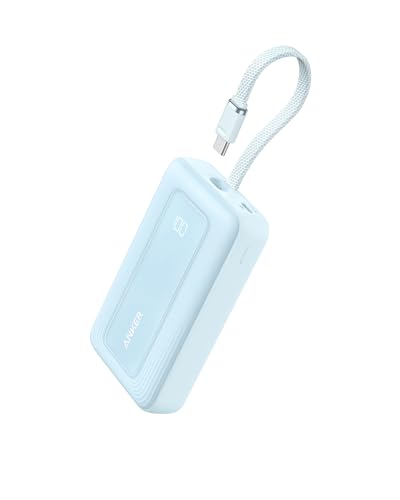
ANKER
Anker Power Bank,10,000mAh 30W with USB-C Travel Essential Portable Charger
The Anker 10,000mAh power bank is positioned as the practical everyday charging option in the article. Its 30W output provides useful charging headroom while its 10,000mAh capacity keeps the balance between battery reserve and portability.
Who Should Buy It
It is best for everyday phone users, commuters, and travelers who want a compact portable charger from an established charging brand. It is particularly suitable when 30W output is enough for the devices being charged.
Why We Pick It
The article selected it as the everyday-use option because 10,000mAh offers a practical balance of capacity and portability. Its 30W output also gives it more charging capability than basic low-output power banks without moving to the larger size of a 20,000mAh model.
Features & Benefits
| Feature | Benefit |
|---|---|
| 10,000mAh Capacity | provides a practical amount of stored energy for everyday phone charging |
| 30W Output | offers useful charging power for compatible phones and other USB-C devices |
| USB-C Charging | provides compatibility with modern USB-C charging setups |
| Portable Design | makes it suitable for commuting, workdays, and normal daily travel |
Pros & Cons
| Pros | Cons |
|---|---|
| ✓ Good balance of capacity and portability | ✕ Lower maximum output than the INIU 45W |
| ✓ 30W charging output | ✕ Less battery reserve than a 20,000mAh power bank |
| ✓ Established Anker brand |
INIU Portable Charger, 20,000mAh 22.5W
Best for Higher Capacity
Best For: Travelers and heavy phone users who need more battery reserve without moving to a large power station.

INIU
INIU Portable Charger, Smallest 20000mAh 22.5W Fast Charging Power Bank
This INIU model is the article's higher-capacity choice, offering 20,000mAh with up to 22.5W output. The larger battery reserve makes it better suited to long trips, frequent charging, and users who carry multiple devices.
Who Should Buy It
It is best for travelers, heavy phone users, and anyone who needs more charging sessions between access to a wall outlet. It is also a good choice when battery reserve matters more than maximum charging wattage.
Why We Pick It
It earned a spot because its 20,000mAh capacity provides twice the advertised capacity of the two 10,000mAh options in the article. The article specifically recommends this capacity for long trips, frequent charging, and several devices.
Features & Benefits
| Feature | Benefit |
|---|---|
| 20,000mAh Capacity | provides substantially more battery reserve for longer trips and multiple charging sessions |
| 22.5W Fast Charging | provides useful charging speed for compatible devices while prioritizing capacity |
| Built-In USB-C Cable | reduces the need to carry a separate charging cable |
| Pocket-Size Design | keeps a high-capacity battery more portable than many larger power banks |
Pros & Cons
| Pros | Cons |
|---|---|
| ✓ Twice the advertised capacity of 10,000mAh picks | ✕ More size and weight than a 10,000mAh model |
| ✓ Strong choice for long trips | ✕ Lower maximum output than the INIU 45W |
| ✓ 4.6-star rating with approximately 28,927 reviews |
How to Choose a Portable Power Bank
Start by identifying the devices you need to charge and how often you expect to recharge them. Then compare capacity, output wattage, ports, charging standards, size, weight, and travel requirements.
A good power bank should solve a specific charging problem. Buying the biggest battery available can add unnecessary weight, while choosing the smallest model can leave you without enough reserve.
Choose the Right Power Bank Capacity
The right power bank capacity depends on how much battery reserve you need between access to wall power. For most daily phone users, 10,000mAh offers a useful balance between capacity and portability.
A 5,000mAh power bank is better for emergency top-ups and minimal carry weight. A 10,000mAh model suits commuting, workdays, and normal daily travel. A 20,000mAh model is better for long trips, frequent charging, or several devices.
| Capacity | Best Use | Main Trade-Off |
|---|---|---|
| 5,000mAh | Emergency top-ups and pocket carry | Limited battery reserve |
| 10,000mAh | Everyday phone charging | Less reserve than 20,000mAh |
| 20,000mAh | Long trips and multiple charges | More size and weight |
Is a Higher mAh Rating Always Better?
No. A higher mAh rating gives you more stored battery capacity, but it also usually increases size and weight.
More capacity can also be unnecessary for someone who only needs an emergency phone top-up. Instead, match capacity to the number of devices and charging sessions you expect.
Also remember that advertised mAh does not mean your device receives every milliamp-hour stored inside the battery. Voltage conversion and charging losses affect usable energy.
How Do You Choose a Good Power Bank for a Mobile Phone?
For a phone, choose a power bank that provides enough capacity for your normal charging pattern and enough output for your phone’s supported charging speed. A 10,000mAh model is a practical starting point for most smartphone users.
Next, check whether the power bank supports the correct USB-C or other connector. A built-in cable can add convenience, but a removable cable gives you more flexibility when devices change.
What Wattage Should a Power Bank Have?
Choose the wattage based on the fastest charging speed your device can actually use. A higher wattage rating does not automatically make every phone charge faster.
For basic phone charging, moderate output can be enough. However, 30W and 45W models provide more headroom for compatible phones, tablets, and some smaller computers.
The INIU 45W model demonstrates why wattage matters when capacity is similar. It has the same 10,000mAh class as the Anker model, but offers a higher maximum output.
Buying tip: Do not confuse battery capacity with charging speed. mAh tells you about stored capacity, while watts tell you how much charging power the output can provide.
Why USB-C Power Delivery Matters
USB-C Power Delivery can provide faster and more flexible charging than basic USB output when the power bank and device support compatible PD profiles.
However, USB-C does not automatically mean high-speed charging. Check the power bank’s actual USB-C input and output ratings before buying.
When comparing power banks, look for the maximum USB-C output rather than relying only on the presence of a USB-C port.
If you want to understand the wider charging technology behind modern USB-C accessories, you can also learn what GaN technology means for chargers.
How Many Ports Do You Need?
Choose the number of ports based on how many devices you normally charge at once. One USB-C port can be enough for a phone, while multiple ports are useful for phones, earbuds, tablets, and other accessories.
Before buying, check whether multiple outputs can operate simultaneously. Some power banks share their available output across ports.
USB-C is increasingly useful because the same port can handle input and output on many modern power banks. USB-A can still help when you have older cables or accessories.
Should You Buy a Power Bank With Built-In Cables?
Built-in cables are useful when convenience matters more than cable flexibility. They reduce the number of separate accessories you need to carry.
However, an integrated cable can become a limitation if it wears out or if you later switch to a different connector. A removable USB-C cable gives you more freedom to replace or upgrade the cable.
How Important Are Size and Weight?
Size and weight matter because a power bank is useful only when you are willing to carry it. A larger battery can provide more energy, but it also takes more space in a pocket or bag.
For everyday commuting, a compact 10,000mAh power bank often makes more sense than a bulky high-capacity model. For extended travel, the extra weight of 20,000mAh may be worthwhile.
When Should You Choose a 20,000mAh Power Bank?
Choose 20,000mAh when you expect several charging sessions before reaching a wall outlet. It is especially useful for long trips, outdoor activities, work travel, and users carrying multiple devices.
The INIU 20,000mAh model is a useful example because it emphasizes capacity while retaining a relatively compact design. It also shows why capacity and output should be evaluated separately.
Can a Power Bank Charge a Laptop?
Yes, but only when the power bank provides enough output power and the laptop supports charging through its available port. A phone-focused power bank may not provide enough wattage for a laptop.
For laptop charging, check the computer’s required input power and compare it with the power bank’s USB-C output. A higher-capacity battery can provide more reserve, but output wattage still determines whether the laptop can accept useful charging power.
Do not assume that every 20,000mAh power bank can charge a laptop. Capacity and output are separate specifications.
Do You Need Wireless or Qi2 Charging?
Wireless charging is useful when cable-free convenience matters more than maximum wired charging speed. Magnetic charging can also make alignment easier on compatible devices and accessories.
However, wired USB-C charging is usually the more flexible choice when you need higher output or want to charge several types of devices.
Choose wireless charging when convenience is a priority. Choose wired USB-C when charging speed, compatibility, and efficiency matter more.
What Is the Difference Between a Power Bank and a Portable Power Station?
A power bank is designed mainly for portable electronics such as phones, tablets, and some laptops. A portable power station is a much larger battery system intended to power higher-load equipment and often includes AC outlets.
Do not buy a portable power station simply because it has a larger battery. If you only need to charge a phone or tablet, a power bank is smaller and easier to carry.
If you are comparing charging standards, our guide to the difference between PD and GaN chargers can help clarify why these terms describe different parts of a charging system.
How Do You Choose a Portable Power Bank for Travel?
For travel, prioritize capacity, weight, charging speed, cable compatibility, and airline battery rules. A compact 10,000mAh model works well for short trips, while 20,000mAh provides more reserve for longer journeys.
For air travel, check the battery’s watt-hour rating rather than relying only on the mAh number. Also check the airline’s current requirements before departure because airline policies can be stricter than baseline regulations.
Power banks and other spare lithium-ion batteries must remain in carry-on baggage under U.S. Federal Aviation Administration guidance. The FAA allows spare lithium-ion batteries up to 100Wh without airline approval, while batteries from 101Wh to 160Wh require airline approval and batteries above 160Wh are prohibited on passenger aircraft. Check the FAA’s current battery travel guidance before flying.
If you are preparing for a flight, a suitable personal-item travel backpack can also make it easier to keep your power bank and charging cables accessible.
How Do You Know if a Power Bank Is Good Quality?
A good power bank should have clear specifications, appropriate safety features, a useful warranty, and a trustworthy manufacturer. Avoid choosing a model solely because it advertises an unusually large capacity at an unusually low price.
Check the manufacturer’s stated output, input, battery capacity, supported charging standards, warranty, and physical design. Then compare those specifications with your devices.
Independent testing can also reveal differences between advertised and real-world performance. That is why learning how to test a power bank is useful when comparing portable chargers.
How Do Portable Power Banks Work?
A portable power bank stores electrical energy in rechargeable battery cells and releases that energy through an output circuit. The output circuit converts and regulates the stored energy so a connected device can charge safely.
When you recharge the power bank, electrical energy flows back into its battery cells. The process involves conversion losses, so the usable energy delivered to a device is lower than the simple advertised mAh figure might suggest.
The power bank also controls charging through its internal electronics. Those controls help manage voltage, current, temperature, and other operating conditions.
How Do You Recharge a Portable Power Bank?
Recharge the power bank through its designated input port using a compatible charger and cable. USB-C input is especially convenient because one modern cable can often handle both charging the power bank and charging other devices.
Recharge time depends on the power bank’s input rating and the charger’s available output. A high-capacity battery can take longer to recharge than a smaller model even when both support fast charging.
For more practical information about using a portable charger, you can also see our guide on using a power bank correctly.
Does GaN Matter When Choosing a Power Bank?
GaN matters more when choosing the charger used to recharge your devices or power bank than when judging the battery capacity itself. Gallium nitride can allow compatible charging hardware to achieve high power in a compact design.
However, do not choose a power bank simply because a listing mentions GaN. Capacity, output wattage, charging standards, ports, and warranty still matter more for the buying decision.
If you also need a compact wall charger, our guide to the Ambrane 33W GaN fast-charging adapter provides a related option.
What Capacity Power Bank Do I Need?
Most users should start with 10,000mAh, while frequent travelers and heavy users should consider 20,000mAh. Smaller 5,000mAh models make sense when portability matters more than battery reserve.
- Choose 5,000mAh: You need emergency top-ups and minimal weight.
- Choose 10,000mAh: You want a practical everyday phone charger.
- Choose 20,000mAh: You need more charging sessions during long trips.
- Choose a larger system: You need AC power or high-load equipment support.
What Is the Best Portable Power Bank for a Laptop?
The best laptop power bank must provide enough USB-C output power for the laptop and enough capacity for the intended runtime. Laptop users should prioritize wattage and USB-C Power Delivery instead of choosing based only on mAh.
For a laptop, check the computer’s charger wattage first. Then choose a power bank with a compatible output that meets the laptop’s requirements.
For smaller laptops and USB-C charging systems, a high-output power bank can be useful. However, larger laptops may require substantially more power than a compact phone-oriented power bank can provide.
How to Test a Power Bank Before You Rely on It
Testing a power bank can reveal whether its real-world performance matches your expectations. Start by checking its physical condition, charging behavior, output speed, recharge time, and ability to maintain stable operation.
Track how long it takes to recharge the power bank. Then test the output with the device you actually plan to charge.
Also check whether the power bank becomes unusually hot, disconnects unexpectedly, or reduces output when multiple devices are connected. Those observations are more useful than relying on a single headline specification.
Common Questions About Choosing a Portable Power Bank
What Is a Power Bank?
A power bank is a portable rechargeable battery that stores electrical energy for charging electronic devices away from a wall outlet. Most consumer models use lithium-ion or lithium-polymer battery technology with regulated USB outputs.
How Do I Choose the Right Power Bank?
Choose the right power bank by matching capacity and output wattage to your devices. Then check ports, charging standards, size, weight, warranty, and travel requirements.
Is 10,000mAh Enough for a Phone?
Yes, 10,000mAh is enough for many everyday phone users. The actual number of charges depends on the phone battery, conversion losses, charging conditions, and how much energy the phone consumes while charging.
Is 20,000mAh Better Than 10,000mAh?
20,000mAh is better when you need more battery reserve, but 10,000mAh is better when portability matters more. Neither capacity is universally better.
Can a Power Bank Charge a Laptop?
Yes, some power banks can charge laptops through USB-C Power Delivery. The power bank must provide enough compatible output wattage for the laptop.
Does a Higher Wattage Power Bank Charge Faster?
Only when the connected device supports the additional power. A 45W power bank does not force a phone to accept 45W if the phone supports a lower charging rate.
How Long Does a Power Bank Last?
A power bank’s useful lifespan depends on battery chemistry, charging cycles, heat, storage conditions, and build quality. Capacity gradually declines as rechargeable cells age.
Can I Take a Power Bank on a Plane?
Yes, power banks can generally be carried in carry-on baggage under applicable rules, but capacity limits and airline policies apply. Check the current requirements for your airline before traveling.
What Is the Difference Between a Power Bank and a Portable Power Station?
A power bank is designed for portable electronics, while a portable power station provides substantially more stored energy and often includes AC outlets for higher-load devices.
Final Thought
The best portable power bank is not necessarily the one with the largest battery. Choose the model that gives your devices enough capacity and charging power without adding unnecessary size or weight.
- Best for Compact Fast Charging: INIU 45W 10,000mAh | View Now at Amazon
- Best for Everyday Charging: Anker 10,000mAh 30W | View Now at Amazon
- Best for Higher Capacity: INIU 20,000mAh 22.5W | View Now at Amazon
Choose the capacity first, then confirm the wattage, ports, charging standards, size, and travel requirements before buying.
Sources and Further Reading
Federal Aviation Administration: Airline Passengers and Batteries