
If you are confused about the difference between PD and GaN charger, the key point is simple: GaN and PD are not competing charging technologies. GaN (Gallium Nitride) refers to the semiconductor technology used inside a charger, while PD (Power Delivery) is a charging protocol that manages how compatible devices receive power.
That means a charger can be both GaN and PD. In fact, a GaN PD charger combines compact, efficient power hardware with USB Power Delivery, making the two technologies complementary rather than alternatives.
Quick Answer: GaN vs PD Charger
GaN is about the charger’s hardware, while PD is about how the charger delivers power. GaN uses Gallium Nitride semiconductor technology to enable compact, efficient power electronics. USB Power Delivery allows compatible devices and chargers to negotiate suitable power levels.
So, when comparing a GaN charger vs a PD charger, you are not really comparing two versions of the same thing. A charger can use GaN internally and support PD at the same time.
Related Posts
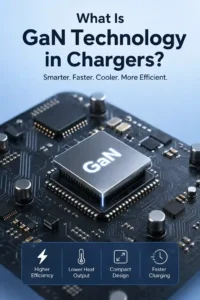 | What Is GaN Technology in Charger? How It Works |
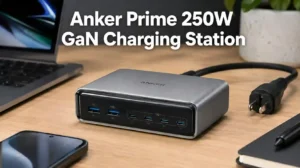 | Anker Prime 250W GaN Charging Station: Is It Still Worth Buying? |
| Feature | GaN | PD |
|---|---|---|
| What it is | Semiconductor technology | Power-delivery protocol |
| Main role | Power conversion hardware | Power negotiation and delivery |
| Main benefit | Compact and efficient charger designs | Flexible power delivery to compatible devices |
| Can they work together? | Yes | Yes |
What Is the Difference Between PD and GaN Charger?
The easiest way to understand the difference between PD and GaN charger is to separate the physical technology from the charging protocol. GaN describes what is used in the charger’s power electronics, whereas PD describes a standardized method for managing power delivery between compatible equipment.
Think of GaN as part of the charger’s engineering and PD as part of its communication and power-management system. One does not replace the other, which is why you will often see modern chargers described as GaN PD chargers.
It is also important not to confuse either term with wattage. A charger being 65W, 100W, or another power rating tells you about its available power output; it does not tell you whether the charger uses GaN or supports PD.
What Is a GaN Charger and How Does It Work?
GaN stands for Gallium Nitride. A GaN charger uses Gallium Nitride semiconductor technology in its power electronics instead of relying entirely on conventional silicon-based components.
The technology can support efficient, high-frequency power conversion, which helps manufacturers build chargers with greater power density. In practical terms, that can mean a charger capable of delivering substantial power without requiring the same physical size as some older designs.
That is why the main advantages of GaN chargers are generally associated with smaller size, efficiency, heat management, and power density, rather than automatically making a device charge faster.
If you want a deeper explanation of the technology itself, the supplied article on GaN technology in chargers is a natural next step.
So, when someone asks how does a GaN charger work, the short answer is that GaN is used in the charger’s power-conversion circuitry to help handle electrical power efficiently in a compact design. The actual charging speed still depends on the charger, device, protocol, cable, and supported power levels.
What Is a PD Charger?
PD stands for Power Delivery. USB Power Delivery is a specification designed to provide flexible power delivery over the USB ecosystem. Instead of simply treating the charger as a fixed power source, compatible devices can negotiate appropriate power requirements.
That is what people mean when they describe PD as a smart charging protocol. A compatible charger and device can determine an appropriate power arrangement instead of the charger simply forcing its maximum rated wattage into every connected device.
The USB Implementers Forum explains that USB Power Delivery provides flexible power delivery and allows devices to take the power they require. The current USB-IF document library lists a USB Power Delivery specification dated May 20, 2026, so the standard is actively maintained. USB-IF’s current Power Delivery documentation is the authoritative reference for the specification.
This explains searches such as what does PD mean in chargers, what does PD mean on a charger, and what does PD stand for in chargers: they are all asking about the Power Delivery protocol rather than the physical material used to build the charger.
What Is a Type-C PD Charger?
A Type-C PD charger is a charger that uses a USB-C connection and supports USB Power Delivery. The important distinction is that USB-C and PD are not the same thing.
USB-C describes the connector and interface, while PD describes a power-delivery protocol. Therefore, seeing a USB-C port does not by itself tell you everything about the charger’s power capabilities.
This distinction matters when comparing the difference between C type charger and normal charger. A USB-C connector can provide a modern physical connection, but the charger’s supported power output and protocols still determine what charging capabilities are available.
For a laptop, tablet, or phone, check the device’s charging requirements rather than choosing a charger based only on the shape of its connector.
How GaN and PD Work Together
The biggest misconception about GaN vs PD is assuming that you must choose one. You do not. A charger can use GaN technology internally and support USB Power Delivery at the same time.
GaN helps with the physical power-conversion side of the charger, while PD manages compatible power delivery. Combining them can therefore produce a charger that is both compact and capable of flexible power delivery.
This is also why the phrase GaN PD charger is so common. It does not describe a third technology competing with GaN and PD; it describes a charger that incorporates both.
A practical example is the Anker Prime 250W GaN charging station, which illustrates how GaN technology can be used in high-power charging hardware. The important lesson is not the individual product, but the distinction between the charger’s hardware technology and its supported charging protocols.
GaN vs Normal Charger and PD vs Normal Charger
The GaN charger vs normal charger comparison is mainly a comparison of power-electronics design. Traditional chargers commonly use silicon-based semiconductor components, while GaN chargers use Gallium Nitride in relevant power circuitry.
GaN can allow manufacturers to build compact, efficient designs, particularly when substantial power needs to fit into a relatively small enclosure. However, a normal silicon charger can still charge a device effectively when its power output and supported charging protocols match the device.
The difference between PD and normal charger is different. PD concerns how compatible equipment negotiates and manages power. A conventional charger may support other charging standards or provide simpler power-delivery behavior.
Therefore, neither GaN nor PD should automatically be treated as a synonym for faster charging. The actual charging result depends on the device and the complete charging system.
What Is PD Charging in a Laptop?
PD charging in a laptop means the laptop supports receiving power through a compatible Power Delivery implementation. The required wattage depends on the particular laptop, so a 45W charger is not automatically equivalent to a 65W charger simply because both support PD.
If a laptop requires more power than the charger can provide, the lower-wattage charger may charge slowly, fail to maintain the battery level under heavy use, or not provide the expected charging performance. Always check the laptop manufacturer’s power requirements before selecting a replacement charger.
The same principle applies to the question, can I use a 45W charger instead of 65W? It depends on the device. The charger must provide an appropriate power level and support the charging requirements of the laptop.
Which Charger Should You Choose?
If your device supports USB Power Delivery, prioritize a charger with the appropriate PD support and wattage. If you also want a smaller charger with high power density, GaN is an attractive hardware choice.
For a phone or tablet, you may not need the highest-wattage charger available. For a laptop or several devices, higher power capacity can become more important. The right choice is therefore based on compatibility and required power first, followed by preferences such as size and portability.
A GaN PD charger can be an especially convenient option when you want both compact hardware and flexible USB Power Delivery. But a standard PD charger can still be perfectly adequate if its size and power characteristics meet your needs.
Frequently Asked Questions About PD and GaN Chargers
What Is a GaN Charger?
A GaN charger uses Gallium Nitride semiconductor technology in its power electronics. Its main practical advantages can include compact size, efficiency, and high power density.
What Is a PD Charger?
A PD charger supports USB Power Delivery, a protocol that allows compatible devices and chargers to negotiate appropriate power delivery.
What Does PD Mean on a Charger?
PD means Power Delivery. It indicates support for the USB Power Delivery charging protocol, provided the charger is correctly specified and compatible with the connected device.
How Does a GaN Charger Work?
A GaN charger uses Gallium Nitride semiconductor components in its power-conversion circuitry. The technology helps manufacturers achieve efficient, compact power designs.
Can a Charger Be Both GaN and PD?
Yes. GaN and PD describe different aspects of a charger, so one charger can use GaN hardware while also supporting USB Power Delivery.
Is a GaN Charger Faster Than a Normal Charger?
Not necessarily. GaN can improve the charger’s power-conversion design and compactness, but charging speed depends on wattage, device support, charging protocols, cable capability, and other factors.
Is PD the Same as Quick Charge?
No. Power Delivery and Qualcomm Quick Charge are different charging technologies. Compatibility with a particular device determines which protocol can provide the expected charging performance.
Will a Powerful GaN PD Charger Damage an Older Device?
A higher-rated charger does not automatically force its maximum wattage into a compatible device. The device and charging system determine the power that is actually used, but compatibility should always be checked before connecting unfamiliar equipment.
Conclusion
The difference between PD and GaN charger becomes much easier to understand once the terms are separated. GaN describes semiconductor technology used in the charger’s power electronics, while PD describes a power-delivery protocol.
GaN can help create smaller and efficient high-power chargers, while PD provides flexible power delivery for compatible devices. They are not alternatives, which is why a GaN PD charger can combine both technologies.
When choosing a charger, check your device’s required wattage and charging compatibility first. Then decide whether GaN’s compact design and power density are worth having. If you regularly carry multiple charging devices, learning how to choose the right portable power bank can also help you build a more practical portable charging setup.