
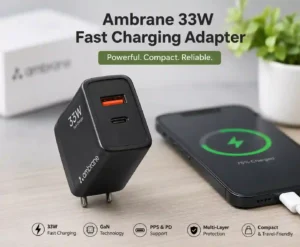
The Ambrane 33W Fast Charging Adapter GaN Charger is a compact single-port USB-C charger designed for compatible smartphones, tablets, and other Type-C devices. Its main appeal is the combination of 33W-class charging, GaN technology, and support for PD, PPS, and VOOC charging standards.
However, a 33W charger does not mean every phone or USB-C device will charge at 33W. The actual charging speed depends on the device, charging protocol, cable, battery level, and power profile supported by the connected device.
This guide explains what the Ambrane Charge 33 offers, how its 30W Type-C and 33W PPS ratings differ, which devices it can charge, whether it is suitable for Samsung and iPhone users, how GaN affects the design, and when a 45W or 65W charger makes more sense.
Quick takeaway: The Ambrane Charge 33 makes the most sense for users who want a small, lightweight, single-port USB-C charger for compatible phones and other Type-C devices. It is less suitable when your main device needs substantially more power than 33W.
 What You Should Know About the Ambrane Charge 33
 What You Should Know About the Ambrane Charge 33
The Ambrane Charge 33 is a 33W GaN fast charging adapter with 1 Type-C port. The official product documentation lists 30W Type-C output and up to 33W through PPS, along with PD, PPS, and VOOC support.
That distinction matters because the advertised 33W figure represents the charger’s maximum supported PPS output. A connected device can request a lower power level based on its own charging requirements.
The charger is also lightweight at 45g. Therefore, its compact design makes it more suitable for everyday carry and travel than a larger high-wattage laptop charger.
Important:
33W is the charger’s maximum capability, not a guarantee that your phone will continuously receive 33W. Your device, cable, battery level, and charging protocol determine the actual power draw.
Ambrane Charge 33 Comparison Table
| Product | Image | Amazon | Best For | Port | Output | Charging Protocols | GaN | Weight |
|---|---|---|---|---|---|---|---|---|
| Ambrane Charge 33 |  🔍 Click image to enlarge | Amazon link to be added after the exact Charge 33 affiliate listing is confirmed | Compact 33W USB-C charging | 1 × Type-C | 30W Type-C / up to 33W PPS | PD, PPS, VOOC | Yes | 45g |
What Is the Ambrane 33W Fast Charging Adapter?
The Ambrane Charge 33 is a compact wall charger built around a single USB-C output. It uses GaN technology and supports several charging protocols to improve compatibility with modern USB-C devices.
The single-port design is important when comparing it with other Ambrane chargers. For example, the RAAP M33 shown in the supplied product research is a separate dual-port 33W charger. It should not be confused with the Charge 33.
Likewise, the Charge X33 is another separate Ambrane product with a different multi-output design. Mixing specifications from these models would give the reader an inaccurate picture of the Charge 33.
Ambrane Charge 33 Specifications Explained
The most useful way to understand the Charge 33 is to look at what each specification means in everyday use.
- Charging technology: GaN
- Output port: 1 × Type-C
- Type-C output: Up to 30W under the listed Type-C output profile
- PPS output: Up to 33W
- Charging protocols: PD, PPS, and VOOC
- Weight: 45g
- Body material: ABS
- Input: 110–240VAC
- Protection: Ambrane SafeCharge Technology
The combination of PD and PPS is especially useful for modern USB-C phones. However, compatibility depends on the charging profile supported by the phone rather than the charger name alone.
That is why the Charge 33 should be viewed as a flexible 33W-class USB-C charger rather than a universal 33W solution for every device.
How Fast Is the Ambrane 33W Charger?
What Does 33W Fast Charging Actually Mean?
33W means the charger can provide up to that level under an appropriate supported charging profile. It does not mean the charger will force 33W into every connected device.
For example, a phone designed to accept a lower charging rate will negotiate a lower power level. The phone controls the amount of power it accepts.
Charging speed also changes during a charging session. A phone may draw more power when the battery is low and gradually reduce power as the battery approaches a high charge level.
Temperature can also affect charging behavior. A warm device may reduce its charging rate to manage heat.
Can I Charge My Phone With a Fast Charger?
Yes. You can charge a compatible phone with a fast charger such as the Ambrane Charge 33.
The important point is that the phone must support the charging protocol and power level you want to use. A higher-wattage charger does not automatically make a phone charge faster if the phone has a lower charging limit.
The cable matters too. A suitable cable must be used between the charger and device to achieve the desired charging mode.
PD, PPS and VOOC Support Explained
The Charge 33 supports Power Delivery, PPS, and VOOC. These technologies help the charger and connected device negotiate an appropriate charging profile.
What Power Delivery Means
USB Power Delivery, commonly called PD, is a charging standard used across many modern USB-C devices.
PD allows a charger and compatible device to negotiate the power level required by the device. Therefore, a PD charger can work with different devices without forcing the same output onto each one.
For the Charge 33, PD support makes the single Type-C port useful across a broad range of compatible USB-C devices.
Why PPS Matters for Samsung Phones
PPS, or Programmable Power Supply, allows more flexible power negotiation than a fixed charging profile.
PPS is particularly relevant to compatible Samsung Galaxy devices because supported Samsung models can use PPS-based charging modes.
However, Samsung compatibility does not mean every Galaxy phone will charge at 33W. The phone model determines its maximum supported charging power and protocol.
If Samsung fast charging is your priority, check the exact charging specification of your Galaxy model before buying a charger.
What VOOC Support Means
VOOC is associated with compatible OPPO and related charging ecosystems. The Charge 33 includes VOOC support, but proprietary fast charging still depends on the connected device and supported charging profile.
In other words, the presence of VOOC on the charger does not guarantee that every OPPO-family device will use its fastest possible charging mode.
For a broader explanation of how charging protocols differ from charger technology, see this guide to the difference between PD and GaN chargers.
Which Devices Can the Ambrane 33W Charger Charge?
The Ambrane Charge 33 is designed for compatible Type-C devices. That includes many smartphones and other USB-C gadgets, while the exact charging speed depends on each device.
iPhone Compatibility
The Charge 33 can be used with compatible USB-C iPhones when paired with the appropriate USB-C charging cable.
The key limitation is not simply the charger’s 33W rating. The iPhone determines how much power it accepts, so a 33W charger does not guarantee that an iPhone will continuously draw 33W.
Older iPhones that use a Lightning connector require a compatible cable with the appropriate connector.
Samsung Galaxy Compatibility
Samsung Galaxy phones can use the Charge 33 when the phone supports the charger’s available charging protocols.
PPS support is particularly useful for compatible Galaxy models. Still, charging performance varies between Galaxy generations and models.
Therefore, check the exact charging specification of your Samsung phone before assuming that the full 33W output will be available.
Android Phones and Other USB-C Devices
Many Android phones use USB-C, but connector type alone does not determine fast-charging compatibility.
The phone also needs to support a compatible charging protocol and power level. Tablets, earbuds, portable accessories, and other USB-C devices can similarly draw the amount of power they require.
This makes the Charge 33 useful as a general compact charger, but it should not be treated as a universal replacement for every manufacturer’s high-power adapter.
Can It Charge a MacBook Air?
Ambrane’s Charge 33 documentation lists MacBook charging among its supported device applications. A suitable USB-C-to-USB-C cable is required.
However, charging a MacBook and charging it at its maximum possible rate are different things. A 33W charger may be useful for compatible MacBook Air charging scenarios, but a higher-wattage adapter can provide more power headroom for demanding workloads.
For users who primarily need a laptop charger, a 45W, 65W, or higher charger may be a better fit depending on the exact laptop.
Does the Ambrane Charge 33 Need a Special Cable?
The charger and cable work as a charging system. Buying a 33W charger does not make every USB-C cable capable of delivering the same charging performance.
For USB-C devices, use a suitable USB-C-to-USB-C cable that supports the required charging power. For Lightning devices, use a compatible USB-C-to-Lightning cable.
A poor-quality or unsuitable cable can limit charging performance. Therefore, the cable should match the device and charging requirements.
This is especially important when troubleshooting slow charging. If a phone does not reach the expected charging rate, check the charger, cable, device protocol, battery level, and temperature rather than blaming the charger immediately.
What GaN Technology Adds to the Ambrane 33W Charger
GaN stands for gallium nitride. It is a semiconductor material used in modern power electronics and has helped manufacturers create smaller, efficient charging adapters.
In practical terms, GaN allows a charger such as the Charge 33 to deliver useful power from a relatively compact body.
That makes GaN particularly attractive for travel. A smaller charger takes less space in a laptop bag, backpack, or travel pouch.
However, GaN does not increase the charger’s maximum output beyond its rated power. The Charge 33 remains a 33W-class charger even though it uses GaN technology.
If you want a deeper explanation, you can read more about what GaN technology means in a charger.
Remember: GaN mainly helps with charger design, efficiency, and size. It does not make a 33W charger equivalent to a 65W or 100W charger.
Does the Ambrane 33W Charger Get Hot?
The Charge 33 can become warm during charging, especially when it is working close to its output limit. Some customer feedback reports manageable warmth, while other users report more noticeable heating.
That difference is not necessarily surprising. Charger temperature can change with ambient temperature, device load, charging stage, power demand, and airflow around the adapter.
A warm charger is not automatically a problem. However, unusual overheating, burning smells, physical damage, electrical noise, or repeated charging interruptions should not be ignored.
Ambrane also lists SafeCharge protection technology for the Charge 33. That is a manufacturer-stated feature, not evidence of independent testing.
For that reason, the fairest conclusion is that heat should be considered a normal operating factor rather than describing the charger as guaranteed to remain cool in every situation.
What Customers Say About the Ambrane 33W Charger
Customer feedback around compact Ambrane chargers tends to focus on several practical areas: charging speed, size, portability, build quality, compatibility, and value.
Positive experiences often center on the convenience of having a small charger that can handle modern USB-C devices.
At the same time, customer experiences with heat and long-term reliability can vary. Individual results also depend on the device being charged and the cable used.
That means customer reviews are useful for identifying recurring concerns, but they should not be treated as a substitute for controlled testing.
The safest buying approach is to combine customer feedback with the manufacturer’s documented specifications and your device’s actual charging requirements.
Ambrane Charge 33 vs Other Ambrane 33W Chargers
Ambrane sells several chargers with similar wattage numbers and model names. That can make product comparisons confusing.
Charge 33 vs RAAP M33
The Charge 33 and RAAP M33 are different products even though both are associated with 33W charging.
The Charge 33 is the compact single-port GaN model discussed in this article. The RAAP M33 is a separate dual-port charger with both USB-A and USB-C outputs.
Therefore, choose based on your port requirements rather than assuming that both products offer the same charging setup.
If you only need to charge 1 USB-C device at a time, the Charge 33’s simpler design may make more sense. If you regularly need 2 charging ports, the dual-port design becomes more relevant.
Charge 33 vs Charge X33
The Charge X33 is another separate Ambrane charger. It should not be treated as an upgraded version of the Charge 33.
The Charge X33 uses a multi-output design and includes an AC socket. Its purpose is therefore different from the compact single-port Charge 33.
Mixing the specifications of these products can lead to incorrect expectations, especially when comparing port count, output, and travel use.
Is 33W Enough, or Should You Buy a 45W or 65W Charger?
The right wattage depends on your device. More wattage is useful only when your device can take advantage of it.
When 33W Makes Sense
A 33W charger is a sensible choice for users who mainly charge smartphones and other compatible USB-C devices.
- Everyday smartphone charging
- Compact travel setups
- Single-device charging
- Compatible tablets and USB-C accessories
- Users who prefer a lightweight charger
The Charge 33 is especially attractive when portability matters more than having enough power for demanding laptops.
When a 45W Charger Makes More Sense
A 45W charger provides additional power headroom for compatible tablets and USB-C laptops.
It can also make sense for users who want 1 charger that comfortably covers both a smartphone and a more demanding USB-C device.
If your device recommends or benefits from 45W charging, consider an appropriate higher-power PD charger rather than choosing a 33W model simply because it is smaller.
When a 65W Charger Makes More Sense
A 65W charger is more appropriate when a USB-C laptop is a central part of your charging setup.
It gives the charger more headroom for devices that can draw substantially more power than a typical smartphone.
However, a 65W charger can be larger and heavier than a compact 33W model. Therefore, the extra power is not automatically worth the additional size for phone-only users.
When 100W Is Unnecessary
A 100W charger is not automatically better for a smartphone.
If your phone only needs a much lower charging level, buying a 100W adapter does not mean the phone will charge at 100W. The device still determines its supported charging rate.
Terms such as 100W GaN charger describe a much higher power class. They do not make sense for every charging setup.
Is Ambrane a Good Charger Brand?
Ambrane can be a reasonable choice when a specific charger offers the output, protocols, compatibility, warranty, and build characteristics you need.
However, the brand name alone should not determine whether a charger is right for you.
For the Charge 33, the important points are its single USB-C port, 33W PPS capability, PD/PPS/VOOC support, compact GaN design, and compatibility with the device you plan to charge.
Customer feedback should also be considered, especially when checking for recurring reports about heat, durability, or charging reliability.
In short, the Ambrane Charge 33 looks most appropriate for users who value compact 33W-class USB-C charging. Users with higher-power laptops or multiple devices should consider a different charger class.
How to Choose the Right Ambrane Charger for Your Device
Check Your Device’s Maximum Charging Power
Start with the device rather than the charger.
Check the phone, tablet, laptop, or accessory manufacturer’s charging specification. Then choose a charger that meets or exceeds the required power and supports the necessary protocol.
Check Charging Protocols
Look for the protocol your device actually uses.
- PD: Important for many USB-C devices.
- PPS: Useful for compatible devices that support programmable power delivery.
- VOOC: Relevant to compatible devices using that charging ecosystem.
Protocol compatibility can matter just as much as the charger’s maximum wattage.
Check the Port Type
The Charge 33 has 1 Type-C port. That makes it straightforward for users who mainly charge 1 USB-C device at a time.
If you regularly charge a phone and another device simultaneously, a dual-port charger may be more practical.
Check the Cable
Use a cable that matches your device and charging requirements.
A charger can support a high charging rate while the connected cable or device limits the actual power delivered.
Choose Portability or Higher Power
The Charge 33 is designed around portability and moderate charging power.
Choose it when compact size and phone charging are the priorities. Move to a 45W or 65W charger when your laptop or other USB-C device needs more power.
If your broader setup includes portable power banks, this guide on how to choose a portable power bank can help you match charging capacity with your travel needs.
Common Questions About the Ambrane 33W Charger
Is Ambrane charger good?
Ambrane can be a good option when the specific charger matches your device’s power and protocol requirements. The Charge 33 is best suited to users who want compact 33W-class USB-C charging.
Can I charge my phone with a fast charger?
Yes. A compatible fast charger can safely charge a phone. The phone negotiates the power it can accept, so a 33W charger does not force 33W into every device.
Can the Ambrane 33W charger charge an iPhone?
Yes, compatible iPhones can be charged with the Charge 33 using the appropriate cable. The actual charging speed depends on the iPhone model and supported charging profile.
Does the Ambrane 33W charger support Samsung PPS?
Yes. The Charge 33 supports PPS. However, the actual Samsung charging speed depends on the specific Galaxy model and its supported charging profile.
Can the Ambrane 33W charger charge a MacBook Air?
Ambrane’s documentation lists MacBook charging support. However, 33W is not the same as the higher power available from many laptop-focused adapters, so charging performance depends on the MacBook model and workload.
Does the Ambrane 33W charger come with a cable?
The Charge 33 itself is a charger adapter. Do not assume a cable is included unless the exact retail package or listing explicitly states that it is included.
Does a 33W charger need a 33W cable?
The cable should support the charging power and protocol required by the device. Using an appropriate, quality cable helps prevent the cable from becoming the limiting part of the charging setup.
Is a GaN charger better than a regular charger?
GaN chargers can offer a smaller and more efficient design. However, GaN does not automatically mean a charger provides more power or faster charging than every conventional charger.
Which charger is best for fast charging?
The best charger is the one that matches your device’s supported wattage, charging protocol, connector, and cable requirements. A higher wattage alone does not guarantee faster charging.
Can I charge my power bank with a fast charger?
Yes, if the power bank supports the charger’s input power and charging protocol. The power bank controls the amount of power it accepts.
Is 33W enough for a phone?
For many smartphones, 33W is a useful level of charging power. However, the actual benefit depends on the phone’s maximum supported charging rate.
Should I buy a 33W, 45W, or 65W charger?
Choose 33W for compact smartphone-focused charging. Choose 45W or 65W when you also need more power for compatible tablets or USB-C laptops.
Final Thought
The Ambrane Charge 33 is most compelling when the goal is simple: a small, lightweight USB-C GaN charger with 33W-class output for compatible everyday devices.
Its PD, PPS, and VOOC support gives it useful compatibility, while the compact 45g design makes it convenient for travel. Still, users should check their device’s charging requirements before buying.
If your phone or other Type-C device works well within the 33W range, the Charge 33 is a practical choice. If your main device is a higher-power laptop, a 45W or 65W charger will usually provide more useful headroom.
- Best for Compact 33W Charging: Ambrane Charge 33
Official reference:Ambrane Charge 33 official documentation